The Growth-Hormone Signal
Tesamorelin
A modified version of the brain's own growth-hormone-releasing hormone, studied for abdominal fat and metabolism.
44 amino acids
GHRH analog
FDA-approved for one specific use

A modified version of the brain's own growth-hormone-releasing hormone, studied for abdominal fat and metabolism.
Deep in the brain, an area called the hypothalamus releases GHRH, growth-hormone-releasing hormone. It tells the pituitary gland to release growth hormone in natural pulses. Growth hormone then helps regulate body composition, metabolism, and tissue maintenance, partly through IGF-1, a messenger made by the liver.
Tesamorelin is a synthetic version of GHRH. It contains all 44 amino acids of the natural hormone, plus a small chemical modification at one end that helps it resist being broken down too quickly.
Think of tesamorelin as a messenger that nudges the pituitary to release the body's own growth hormone, rather than supplying growth hormone itself.
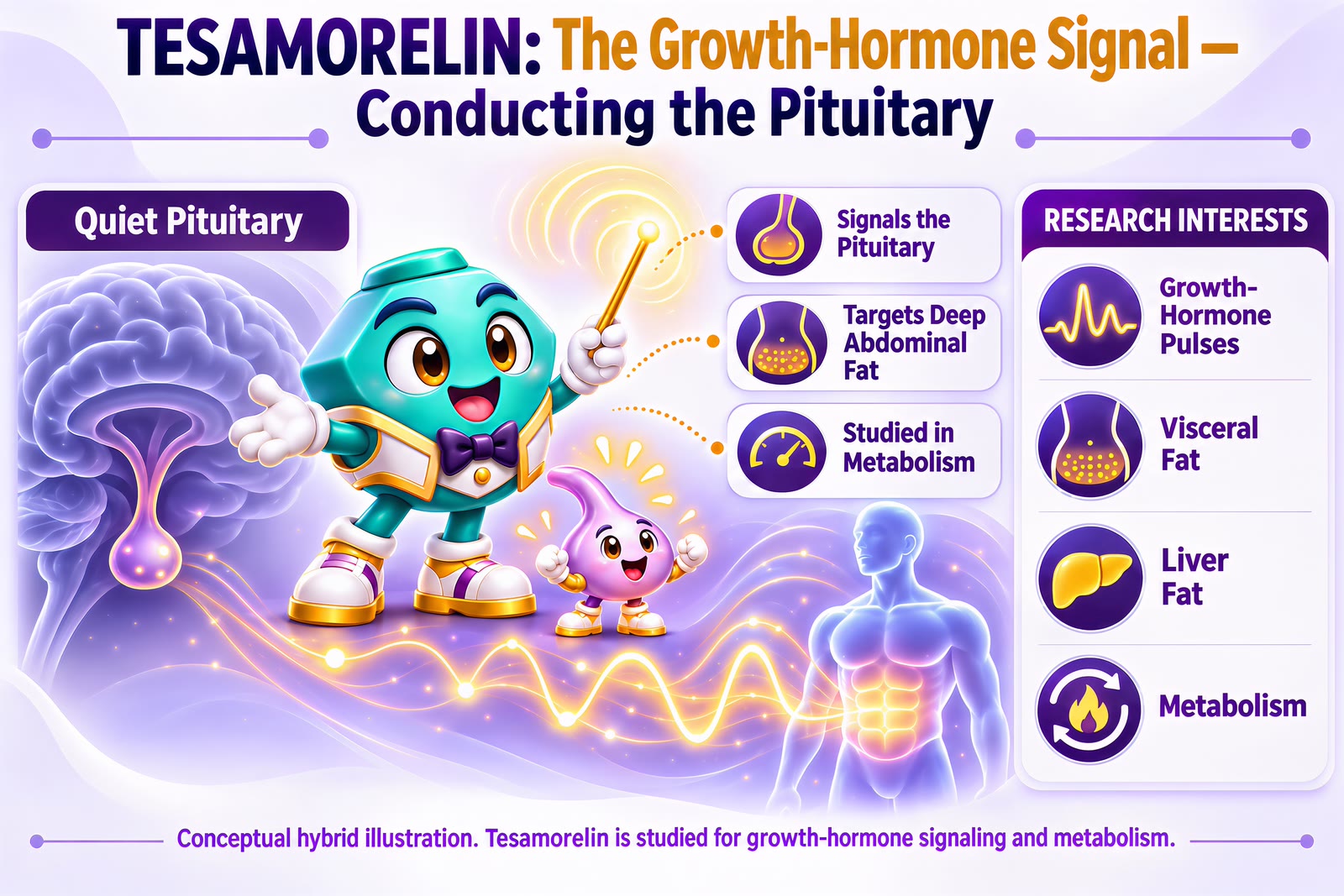
Tesamorelin binds the GHRH receptor on the pituitary and prompts it to release growth hormone. Because the signal goes through the pituitary's own control system, the body's normal feedback mechanisms stay involved.
Visceral fat is the deep abdominal fat that packs around the organs, and it is linked with metabolic risk. Growth hormone signaling influences how the body stores and breaks down fat.
Researchers have also explored tesamorelin in relation to liver fat and, in early studies, to memory and thinking in older adults. These remain research questions.
Tesamorelin, sold under the brand name Egrifta, was approved by the FDA on November 10, 2010 to reduce excess abdominal fat in adults with HIV who have lipodystrophy, a condition that causes unusual fat build-up.
The approval is specific to that use. Tesamorelin is not approved for general weight loss or other body-composition goals, and research-grade tesamorelin is not the approved medicine.
Most peptides in this series work through repair, inflammation, or cellular energy. Tesamorelin works through the growth-hormone axis, one of the body's main control systems for metabolism and body composition.
It is also one of the better-studied peptides here, because it has a full set of clinical trials behind an approved medicine.
Tesamorelin is a well-defined, well-studied GHRH analog with an approved use in a specific population and early research in several other areas.
The Peptide Curious takeaway: Think of tesamorelin as a signal to the pituitary. Researchers are studying how nudging the body's own growth-hormone system may influence fat, metabolism, and more.
Peptide Curious provides educational and editorial content only. It is not medical advice and is not a substitute for a qualified healthcare professional. Tesamorelin is discussed here as a research compound; content may describe emerging research not approved for clinical use.