The Hormone Messenger
HCG
The pregnancy hormone: a signal the body uses to keep reproduction on track, with a long clinical history.
Glycoprotein hormone
Made by the placenta
The hormone behind pregnancy tests

The pregnancy hormone: a signal the body uses to keep reproduction on track, with a long clinical history.
HCG stands for human chorionic gonadotropin. It is a hormone made mostly by the placenta during pregnancy, and it is the hormone that home pregnancy tests detect.
Unlike the small peptides explained elsewhere on this site, hCG is a large glycoprotein: a protein with sugar chains attached, built from two linked parts (subunits) and about 237 amino acids in total.
Think of hCG as a messenger that looks a lot like luteinizing hormone (LH). It binds the same receptor, but it lasts much longer in the body.
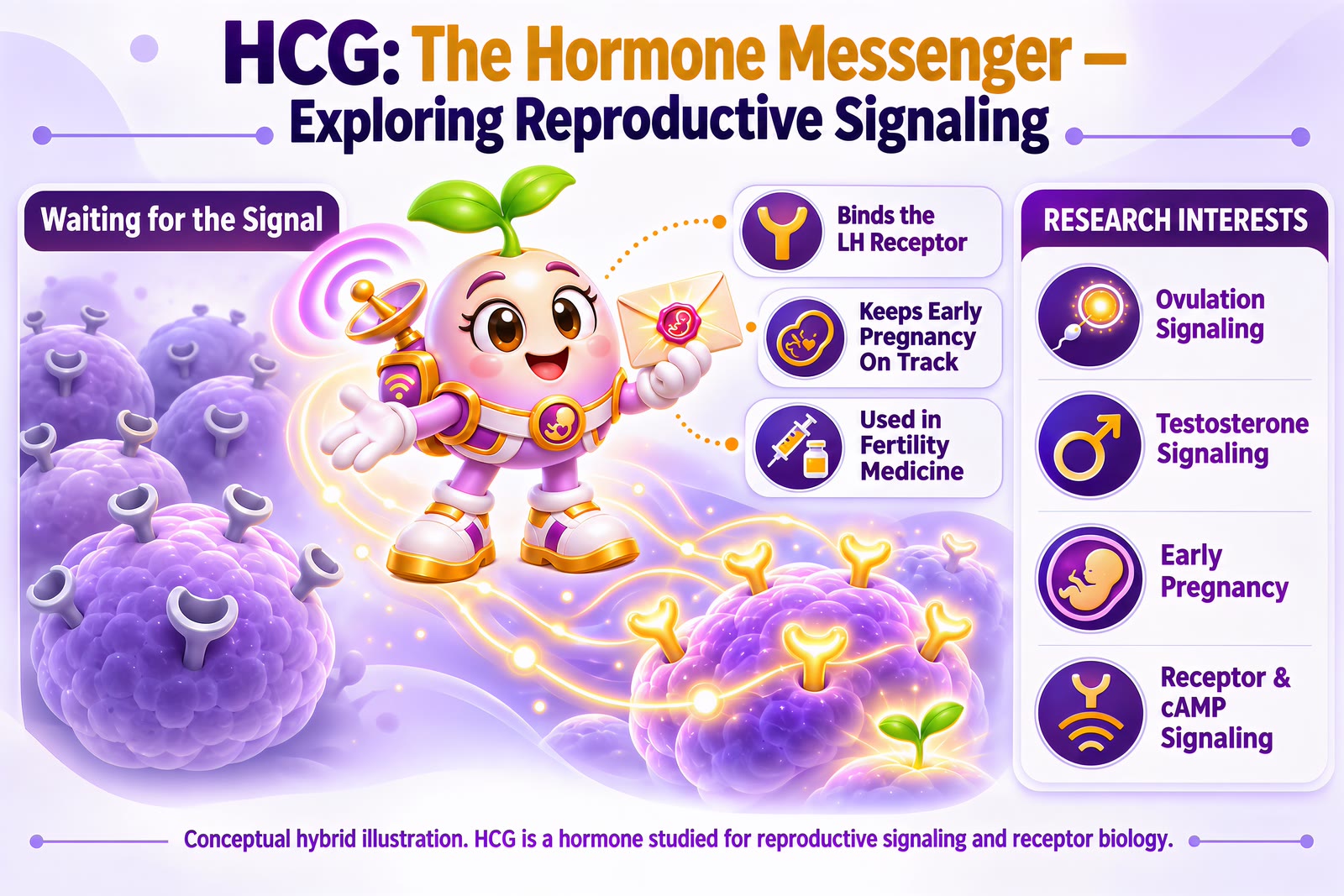
In early pregnancy, hCG tells the corpus luteum, a small structure in the ovary, to keep making progesterone until the placenta can take over that job.
Because hCG binds the LH receptor, it can trigger the same signals: in women it can prompt ovulation, and in men it can signal the testes to make testosterone.
In laboratory research, scientists study how hCG binds its receptor and activates a messenger molecule called cAMP inside cells.
HCG medicines have been FDA-approved for decades for specific, medically supervised uses, including:
Since the 1950s, some people have promoted hCG combined with a very low-calorie diet as a weight-loss method.
The FDA states that there is no substantial evidence that hCG increases weight loss beyond what the low-calorie diet alone produces, and the labels on approved hCG medicines say so. The FDA and the Federal Trade Commission have also taken action against over-the-counter products sold with hCG weight-loss claims.
In everyday language: the diet, not the hormone, is what produces the weight change.
HCG is FDA-approved as a prescription medicine for the specific uses above. It is not approved for weight loss.
Most peptides on this site are small fragments studied for tissue repair, inflammation, or energy. HCG is a full hormone with a clear, well-understood job in reproduction, which is why it has such a long history in medicine.
HCG is one of the best-understood hormones in reproductive medicine. It is also one of the most misunderstood, because of the weight-loss claims that grew up around it.
The Peptide Curious takeaway: Think of hCG as a long-lasting reproductive messenger. Its proven uses are specific and medical, and its popular reputation goes well beyond what the evidence supports.
Peptide Curious provides educational and editorial content only. It is not medical advice and is not a substitute for a qualified healthcare professional. HCG is discussed here as a hormone and research compound; content may describe emerging research not approved for clinical use.