Calm & Stress Response
Selank
The calm-signal peptide, exploring stress response, anxiety pathways, and the link between the brain and the immune system.
7 amino acids
Derived from tuftsin
Developed in Russia

The calm-signal peptide, exploring stress response, anxiety pathways, and the link between the brain and the immune system.
Everyone has a stress response. It helps you react to a challenge, but when it stays switched on, it can affect mood, sleep, focus, and even how your immune system behaves.
Selank is a synthetic peptide built from a small natural fragment of the immune system called tuftsin. Researchers added a short three-amino-acid tail to help it resist being broken down, creating a seven-amino-acid peptide.
Scientists are particularly interested in Selank because it sits where two closely linked systems meet: the nervous system and the immune system.
Think of Selank as a calm-signal research peptide: researchers are investigating how it may influence the signals involved in stress, mood, and emotional balance.
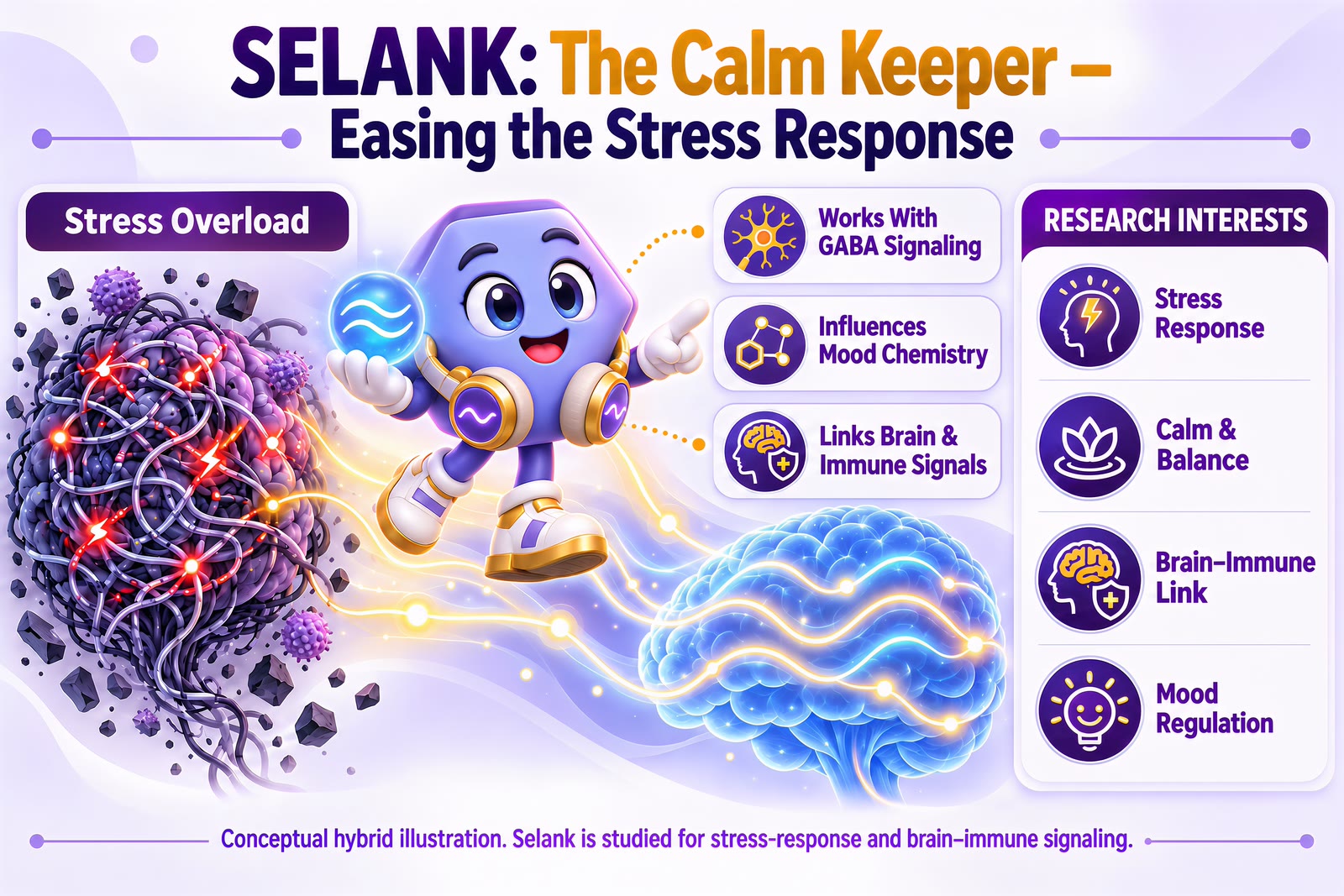
GABA is the brain's main calming messenger. It helps slow down nerve activity so the brain is not constantly firing at full speed.
Laboratory and animal studies suggest Selank can influence GABA-related signaling, which is one reason it is often discussed alongside anxiety-related pathways.
Researchers have also explored how Selank relates to enkephalins (natural peptides involved in stress and pain signaling) and to neurotransmitters such as serotonin and dopamine.
These chemical messengers help shape mood, motivation, and how we respond to pressure.
Because Selank began as an immune-system fragment, researchers have studied whether it influences cytokines, the signaling proteins that immune cells use to communicate.
The big idea: stress and immunity talk to each other, and Selank is studied at the point where they meet.
Animal studies have reported changes in BDNF, the brain growth factor that is also a major focus of Semax research.
Most of the human research on Selank comes from Russia. Small clinical studies in people with anxiety-related conditions reported lower anxiety scores, and one study that compared Selank with an established anti-anxiety medication reported similar results over the study period.
However, these studies were small, many were not designed to modern international standards, and they have not been independently replicated in large trials outside Russia.
Selank was developed at the Institute of Molecular Genetics of the Russian Academy of Sciences, the same research tradition that produced Semax.
In Russia, it has been approved as an anti-anxiety medication.
Selank is not FDA-approved as a medication in the United States. Approval in Russia does not automatically establish safety or effectiveness under U.S. regulatory standards.
These two peptides are often mentioned together because they share a stabilizing tail and a Russian research origin. They are studied for different things.
They are related, but they are not interchangeable.
Selank is a small, stabilized peptide with a long history in Russian research and an unusual link between the immune system and the nervous system. Its possible effects on GABA signaling, mood chemistry, and stress response keep researchers interested.
The Peptide Curious takeaway: Think of Selank as the stress-response specialist. Researchers are exploring how it may influence the signals that help the brain and immune system stay balanced under pressure.
Peptide Curious provides educational and editorial content only. It is not medical advice and is not a substitute for a qualified healthcare professional. Selank is discussed here as a research/investigational compound; content may describe emerging research not approved for clinical use.