Mental Clarity
Semax
The brain's cognitive support peptide, exploring memory, focus, brain health, and neuroplasticity.
7 amino acids
Derived from ACTH
Developed in the 1980s

The brain's cognitive support peptide, exploring memory, focus, brain health, and neuroplasticity.
Your brain is constantly adapting, learning, and creating new connections. This ability is called neuroplasticity, and it plays an important role in memory, learning, and cognitive function.
Semax is a synthetic peptide developed from a small fragment of a naturally occurring hormone called ACTH (adrenocorticotropic hormone).
It contains seven amino acids and was specifically designed to influence brain-related pathways without producing the hormonal effects of full-length ACTH.
Researchers are particularly interested in Semax because of its relationship with BDNF, a protein that helps support the growth, maintenance, and communication of brain cells.
Think of Semax as a brain-support research peptide: scientists are investigating how it may influence the systems involved in learning, memory, and neurological recovery.
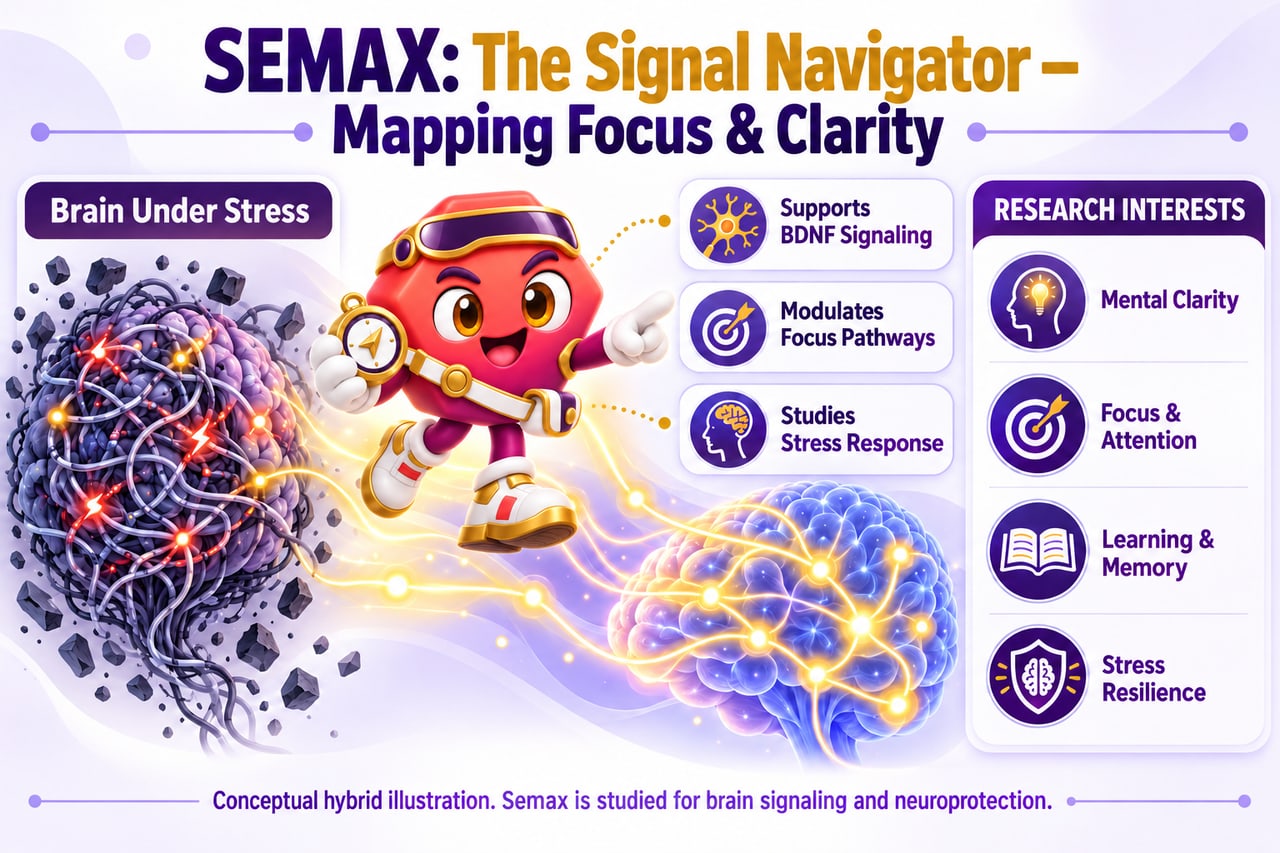
One of the most interesting areas of Semax research involves BDNF (brain-derived neurotrophic factor).
BDNF is a naturally occurring protein that helps:
Animal studies have found that Semax can influence BDNF signaling in certain brain regions.
Why does this matter?
Think of BDNF as fertilizer for the brain's communication network. It helps maintain the connections that allow brain cells to communicate and adapt.
Semax has been studied for its potential effects on cognitive function.
Researchers have explored its relationship with neurotransmitters such as dopamine and serotonin.
These chemical messengers play important roles in:
Some early human research has explored Semax and cognitive performance, but there is not enough high-quality evidence to establish that it improves memory or focus in healthy adults.
Neuroprotection refers to processes that help protect brain cells from damage.
Researchers have investigated Semax in experimental models involving reduced blood flow to the brain, oxygen deprivation, and neurological injury.
This is particularly interesting in stroke research, where brain tissue can be damaged when its blood supply is interrupted.
Russian clinical research has explored Semax as an additional treatment during stroke recovery.
The goal is to understand whether it may influence the biological processes involved in protecting brain cells and supporting neurological recovery.
The brain relies on several chemical signaling systems to respond to stress and changing demands.
Semax has been investigated for its potential effects on neurotransmitter activity and other neurological signaling pathways.
Researchers are interested in how these effects may relate to:
These remain research questions rather than established benefits for healthy individuals.
This is one of the most interesting things about Semax.
Unlike many newer research peptides, Semax has a history that goes back several decades.
It was developed in the Soviet Union during the 1980s by researchers at the Institute of Molecular Genetics in Moscow.
Its development focused on creating a more stable version of an ACTH-derived peptide with potential neurological applications.
These historical registrations demonstrate that Semax has been studied and used outside the United States for many years.
As of 2026, its Russian authorization dates back approximately 32 years.
The former Yugoslav registration is historical; it should not be interpreted as current approval throughout the countries that later emerged from Yugoslavia.
Semax is not FDA-approved as a medication in the United States. Its historical approval in other countries does not automatically establish its safety or effectiveness under U.S. regulatory standards.
Semax is particularly interesting because its research focuses on the nervous system rather than primarily on metabolism, inflammation, or structural tissue repair.
Its research areas include:
This makes Semax a different category of research from peptides such as MOTS-c, BPC-157, and KPV.
These two peptides are often discussed together because both originated from Russian peptide research and share a similar stabilizing peptide sequence.
However, they have different origins and research interests.
Primarily studied for:
Primarily studied for:
Both are interesting areas of neurological research, but they are not interchangeable.
Semax is a well-established subject of Russian neurological research with a history dating back to the 1980s and medical authorization dating to 1994.
Its relationship with BDNF, neuroplasticity, neurotransmitter signaling, and neurological recovery makes it particularly interesting to researchers studying brain health.
The Peptide Curious takeaway: Think of Semax as the brain's communication specialist. Researchers are exploring how it may influence the signals that help brain cells connect, communicate, adapt, and recover.
Educational and editorial content only. Not medical advice. Semax is discussed here as a research/investigational compound; content may describe emerging research not approved for clinical use.