The cellular energy molecule, supporting energy production, DNA repair, mitochondrial function, and healthy aging.
Coenzyme, not a peptideCentral to mitochondrial energy productionLevels can decline with age
What if there were one molecule that nearly every cell in your body depended on to produce energy and maintain its normal functions?
There is. It's called NAD+.
NAD+ stands for nicotinamide adenine dinucleotide. It is a coenzyme found in every living cell and plays an essential role in converting the food you eat into energy.
Unlike peptides, NAD+ is a coenzyme. It is not a protein or a chain of amino acids. However, it is closely connected to many of the cellular processes researchers are investigating in longevity and metabolic health.
One reason NAD+ has attracted so much attention is that its levels can decline with age, potentially affecting several important cellular processes.
Think of NAD+ as the cellular power supply: without enough available NAD+, many of the systems responsible for energy production, DNA maintenance, and cellular protection cannot function normally.
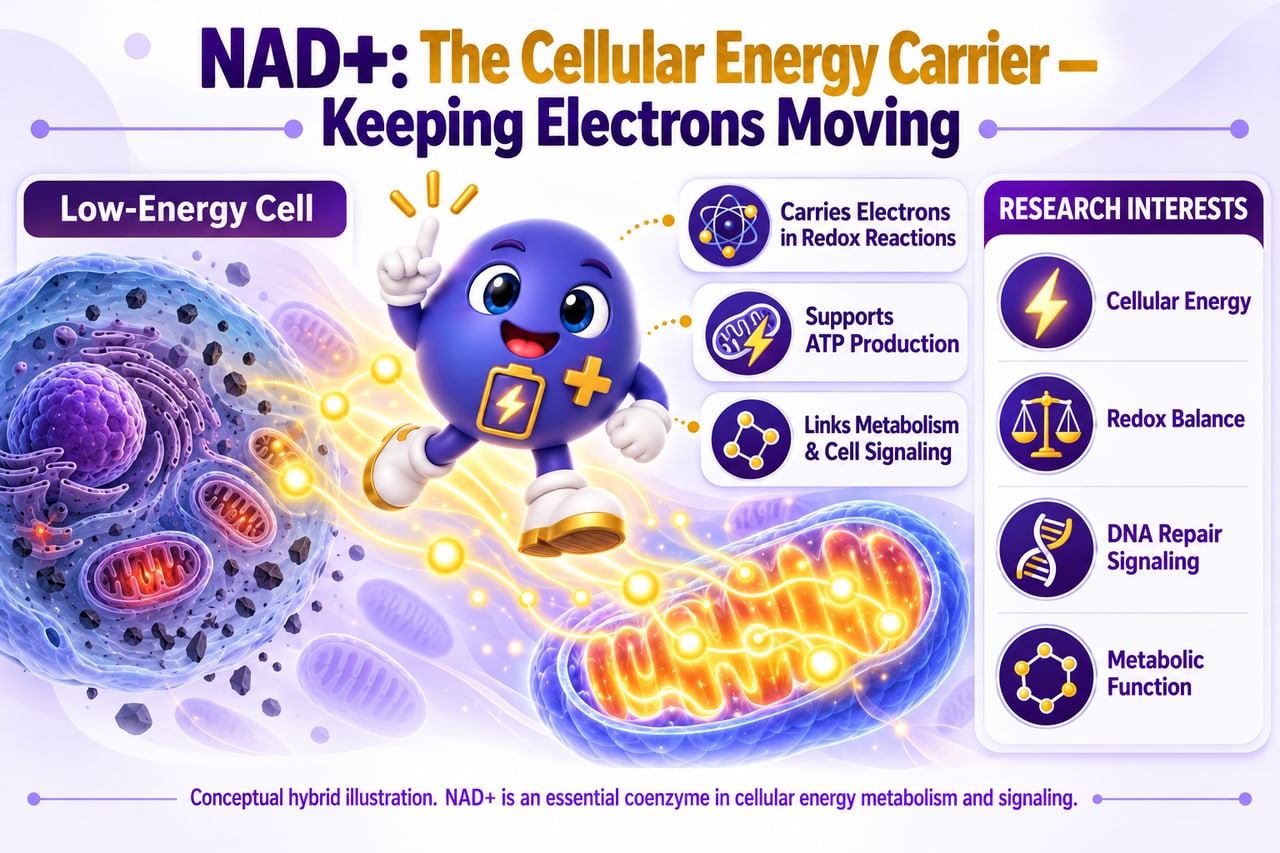
Conceptual overview. NAD+ is studied for its role in cellular energy metabolism and signaling — a simplified overview, not a clinical claim.
How NAD+ Works in the Body
1. Helps Produce Cellular Energy
Every cell needs energy to function.
NAD+ plays a central role in the process of converting carbohydrates, fats, and other nutrients into usable energy.
It works as an electron carrier, switching between two forms:
NAD+: The oxidized form that accepts electrons.
NADH: The reduced form that carries those electrons to other reactions.
NADH delivers electrons to the mitochondrial electron transport chain, helping drive the production of ATP.
ATP is the energy currency of your cells.
Why does this matter?
Your muscles need ATP to move.
Your brain needs ATP to communicate.
Your heart needs ATP to keep beating.
Your organs depend on ATP to perform their everyday functions.
In simple terms, NAD+ helps turn the food you eat into the energy your body uses.
2. Supports Mitochondrial Function
Mitochondria are often called the powerhouses of the cell.
They are responsible for producing much of the energy your body needs.
NAD+ is essential to many of the chemical reactions that take place during mitochondrial energy production.
Researchers are investigating how maintaining NAD+ availability may influence:
Mitochondrial energy production.
Cellular metabolism.
Oxidative balance.
Normal mitochondrial function.
Age-related changes in energy metabolism.
Healthy mitochondria are important for maintaining the energy needs of virtually every organ system.
3. Supports DNA Repair
Your DNA contains the instructions that tell your cells how to function.
Over time, DNA can experience damage from normal cellular activity, environmental exposures, and oxidative stress.
NAD+ is required by enzymes called PARPs (poly ADP-ribose polymerases), which participate in detecting and responding to DNA damage.
NAD+ is also required by another group of enzymes called sirtuins.
These enzymes are involved in:
Cellular stress responses.
DNA maintenance.
Metabolic regulation.
Cellular signaling.
Healthy aging research.
One interesting aspect is that DNA repair itself consumes NAD+.
This is why researchers are interested in the relationship between NAD+ availability, DNA maintenance, and aging.
4. Supports Sirtuins and Healthy Aging Research
Sirtuins are a family of proteins that depend on NAD+ to perform their functions.
They are involved in regulating several important cellular processes.
Researchers are particularly interested in their relationship with:
Cellular stress resistance.
Metabolic regulation.
Mitochondrial function.
Inflammation-related signaling.
DNA maintenance.
As NAD+ availability changes with age, researchers are investigating whether this affects sirtuin activity and other processes associated with healthy aging.
This is one of the biggest reasons NAD+ has become such an important subject in longevity research.
5. Plays a Role in Metabolic Health
Your body constantly switches between different fuel sources to meet its energy needs.
NAD+ is involved in the metabolic reactions that allow cells to process glucose, fats, and other nutrients.
It is particularly important in:
Glucose metabolism.
Fatty acid oxidation.
Cellular energy production.
Mitochondrial metabolism.
Redox balance.
Researchers are exploring whether maintaining NAD+ availability may help support healthier metabolic function as the body ages.
Importantly, NAD+ is not a proven weight-loss treatment, and increasing NAD+ levels does not automatically result in increased fat burning.
Why Do NAD+ Levels Matter as We Age?
One of the major areas of NAD+ research involves aging.
Studies have found that NAD+ metabolism can change with age, although the extent of these changes varies by tissue, individual, and measurement method.
Researchers are investigating whether age-related changes in NAD+ availability may contribute to:
Reduced mitochondrial efficiency.
Changes in cellular energy production.
Altered DNA-repair activity.
Changes in metabolic function.
Reduced cellular stress resilience.
This has created significant interest in understanding whether supporting NAD+ metabolism could help maintain normal cellular function during aging.
NAD+ vs. NMN vs. NR: What's the Difference?
These three molecules are closely related but are not the same thing.
NAD+: The Finished Coenzyme
NAD+ is the molecule cells use directly in thousands of biochemical reactions involving energy metabolism and cellular signaling.
NMN: A Building Block
Nicotinamide mononucleotide is a precursor that the body can use to produce NAD+.
NR: Another Building Block
Nicotinamide riboside is another NAD+ precursor that can be converted into NMN and then NAD+.
Think of it this way:
NMN and NR are building materials. NAD+ is the finished molecule your cells need.
Human studies have shown that oral NR and NMN can increase certain NAD+ measurements, but improvements in measurable NAD+ levels do not automatically mean improved health or longer life.
What Does the Research Say?
NAD+ research is expanding rapidly.
Scientists are investigating its potential relevance to:
Mitochondrial health.
Metabolic dysfunction.
Age-related cellular changes.
DNA repair.
Neurological health.
Cardiovascular health.
Cellular stress responses.
Human research has demonstrated that certain NAD+ precursors can increase NAD+ levels or related metabolites.
However, evidence that increasing NAD+ produces meaningful improvements in lifespan, energy, physical performance, or overall health remains limited.
Direct human evidence for intravenous NAD+ is particularly limited.
Is NAD+ FDA Approved?
This is an important distinction.
NAD+ is naturally present in the human body, but that does not mean every NAD+ product is FDA-approved.
As of November 2026:
No FDA-approved NAD+ drug product has been identified.
NAD+ appears on the FDA's Category 1 list of bulk substances under evaluation for 503A pharmacy compounding.
Category 1 status is not FDA approval.
Compounded NAD+ injections and IV preparations are not FDA-approved medications.
The FDA has also warned compounders about using food-grade NAD+ ingredients in sterile injectable preparations. It has received reports of severe chills, shaking, vomiting, and fatigue following NAD+ injections, with some patients requiring medical attention.
The quality and sterility of injectable products are therefore important safety considerations.
The Bottom Line
NAD+ is one of the most important molecules involved in cellular energy production and maintenance.
It helps cells convert nutrients into energy, supports mitochondrial function, and provides the building blocks needed by enzymes involved in DNA repair and cellular stress responses.
Its relationship with aging, metabolism, and mitochondrial health makes it one of the most fascinating areas of longevity research.
The Peptide Curious takeaway: Think of NAD+ as the cellular power supply. It helps keep the energy-producing and maintenance systems inside your cells running.
The big idea? Healthy cells need more than fuel. They need the molecular machinery to turn that fuel into energy and maintain normal cellular function.
Important research note: NAD+ is a naturally occurring coenzyme, not a peptide. Although its biological importance is well established, the clinical benefits of NAD+ supplementation and IV administration remain under investigation. NAD+ is not FDA-approved as an injectable medication or anti-aging treatment in the United States.
Keep exploring
MOTS-c — a mitochondrial-derived peptide studied for a different angle on cellular energy
Glutathione — a redox-balance antioxidant often discussed alongside NAD+
Peptide Curious provides educational and editorial content only. It is not medical advice and is not a substitute for a qualified healthcare professional. NAD+ is discussed here as a research compound; content may describe emerging research not approved for clinical use.