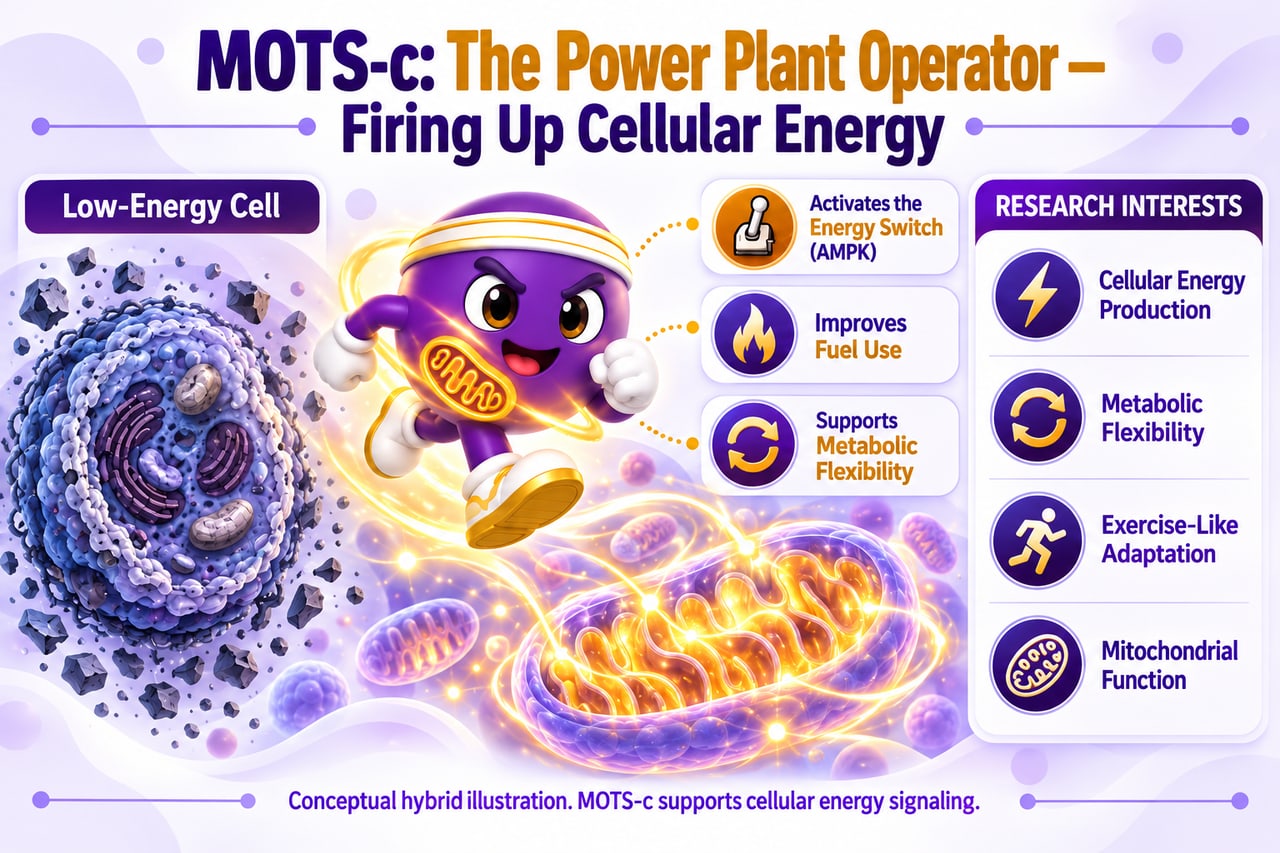
The metabolic power plant operator, supporting energy production, insulin sensitivity, fat metabolism, and metabolic flexibility.
16 amino acidsMitochondrial-derived (a "mitokine")Rises with exercise
Your body has trillions of tiny power plants inside its cells. They're called mitochondria, and their job is to help turn nutrients into usable energy.
But mitochondria do more than produce energy. They also send signals that help regulate how the body uses fuel.
MOTS-c is a fascinating peptide that comes directly from mitochondrial DNA. Researchers are studying how it communicates with the rest of the body to influence metabolism, blood sugar regulation, and energy production.
Think of MOTS-c as the power plant operator: helping researchers understand how cells manage energy, use fuel, and respond to metabolic stress.
Conceptual overview. MOTS-c is studied for switching on the cell's energy-sensing pathway — a simplified overview, not a clinical claim.
How MOTS-c May Support Metabolic Health
1. Helps the Body Become More Efficient at Using Energy
One of the most important pathways studied with MOTS-c is AMPK.
AMPK is often called the body's cellular energy sensor. It helps cells recognize when energy is needed and adjust how they use available fuel.
When AMPK is activated, cells can shift toward using more available energy rather than focusing on storing it.
Researchers are investigating how MOTS-c may influence this process.
Why does this matter?
Helps regulate how cells use energy.
Influences glucose and fat metabolism.
Supports metabolic flexibility.
May help cells respond to changes in energy demand.
Think of AMPK as the switch that tells the cell to pay attention to how it's using its fuel.
2. Supports Insulin Sensitivity and Blood Sugar Regulation
Insulin helps move glucose (sugar) from the bloodstream into cells, where it can be used for energy.
When cells become insulin resistant, they don't respond as effectively to insulin. This can make blood sugar regulation more difficult and contribute to metabolic dysfunction.
In laboratory and animal studies, MOTS-c has demonstrated effects on insulin signaling and glucose uptake.
Researchers are particularly interested in whether MOTS-c may help:
Improve how cells respond to insulin.
Support glucose uptake into muscle cells.
Improve metabolic regulation.
Reduce some effects of diet-related insulin resistance.
In simple terms, the research is exploring whether MOTS-c can help cells become better at using the sugar available to them.
3. Encourages the Body to Use Fat as Fuel
This is one of the most interesting areas of MOTS-c research.
The body can use different sources of energy, including glucose and stored fat.
Metabolic flexibility is the ability to switch between these fuel sources depending on what the body needs.
MOTS-c is being studied for its influence on AMPK and other pathways involved in energy and fat metabolism.
Researchers are exploring whether these effects may help:
Support the use of different energy sources.
Influence fat metabolism.
Improve metabolic flexibility.
Reduce certain metabolic changes associated with excess calorie intake.
The goal is to better understand how the body can use its available energy more effectively.
4. Supports Mitochondrial Function
Mitochondria are responsible for producing much of the energy cells need to function.
When mitochondrial function is impaired, cells may become less efficient at producing and managing energy.
MOTS-c research has explored its relationship with PGC-1α, a signaling regulator involved in mitochondrial function and the development of new mitochondria.
Researchers are investigating whether MOTS-c may help:
Support mitochondrial energy production.
Improve cellular energy efficiency.
Influence mitochondrial adaptation.
Protect cells from certain forms of metabolic stress.
In other words, MOTS-c research isn't just about using fuel. It's also about how efficiently cells turn that fuel into energy.
5. Connects Metabolism With Exercise and Physical Activity
One particularly interesting finding is the relationship between MOTS-c and exercise.
Research suggests that the body's naturally produced MOTS-c can change in response to physical activity.
This has led researchers to investigate its potential role in exercise-related metabolic adaptation.
The questions include:
How does exercise influence mitochondrial signaling?
How do cells adapt to increased energy demands?
Can MOTS-c influence exercise-related metabolic pathways?
Does it play a role in maintaining metabolic health as we age?
This is why MOTS-c is sometimes described as an exercise-mimetic research peptide.
However, this does not mean taking MOTS-c has been shown to reproduce the benefits of exercise in humans.
Why Is MOTS-c Interesting for Weight Management Research?
Weight management involves much more than appetite.
The body must regulate:
How it responds to insulin.
How it processes glucose.
How it uses stored fat.
How efficiently it produces energy.
How it adapts to changing energy demands.
MOTS-c is particularly interesting because researchers are studying its influence on several of these processes through mitochondrial signaling and AMPK activation.
Rather than focusing primarily on appetite suppression, MOTS-c research explores the body's underlying energy-management systems.
The Bottom Line
MOTS-c is one of the most interesting mitochondrial-derived peptides being studied in metabolic research.
Its potential relationship with AMPK, insulin sensitivity, glucose uptake, fat metabolism, and mitochondrial function makes it an exciting area of investigation.
The Peptide Curious takeaway: Think of MOTS-c as the power plant operator. Researchers are exploring how it may help cells manage fuel, respond to energy demands, and maintain metabolic flexibility.
The big idea? Better understanding how cells use energy could open new directions in metabolic health and weight-management research.
Important research note: Most evidence involving administered MOTS-c comes from laboratory and animal studies. Human research has examined naturally occurring MOTS-c levels and exercise responses, but this does not establish that administering MOTS-c produces the same effects. Its safety and effectiveness for weight loss, insulin resistance, or metabolic disease have not been established. MOTS-c is not an FDA-approved medication.
Keep exploring
SS-31 (Elamipretide) — a different mitochondria-targeted peptide, more repair tool than signal
Educational and editorial content only. Not medical advice. MOTS-c is discussed here as a research compound; content may describe emerging research not approved for clinical use.