The Cellular Defender
Glutathione
Your cells' built-in defense system, and a key player in liver detoxification.
3 amino acids (tripeptide)
Most abundant intracellular antioxidant
Central to liver detoxification

Your cells' built-in defense system, and a key player in liver detoxification.
Glutathione is a small but powerful tripeptide made from three amino acids: glutamate, cysteine, and glycine. Found in nearly every cell in the body, it is often called the body's master antioxidant because it helps protect cells from oxidative stress and supports the body's natural detoxification processes.
One of its most important jobs takes place in the liver. Glutathione helps the liver process certain toxins, medications, and other foreign compounds so the body can eliminate them.
Think of glutathione as both a cellular bodyguard and part of the liver's cleanup crew.
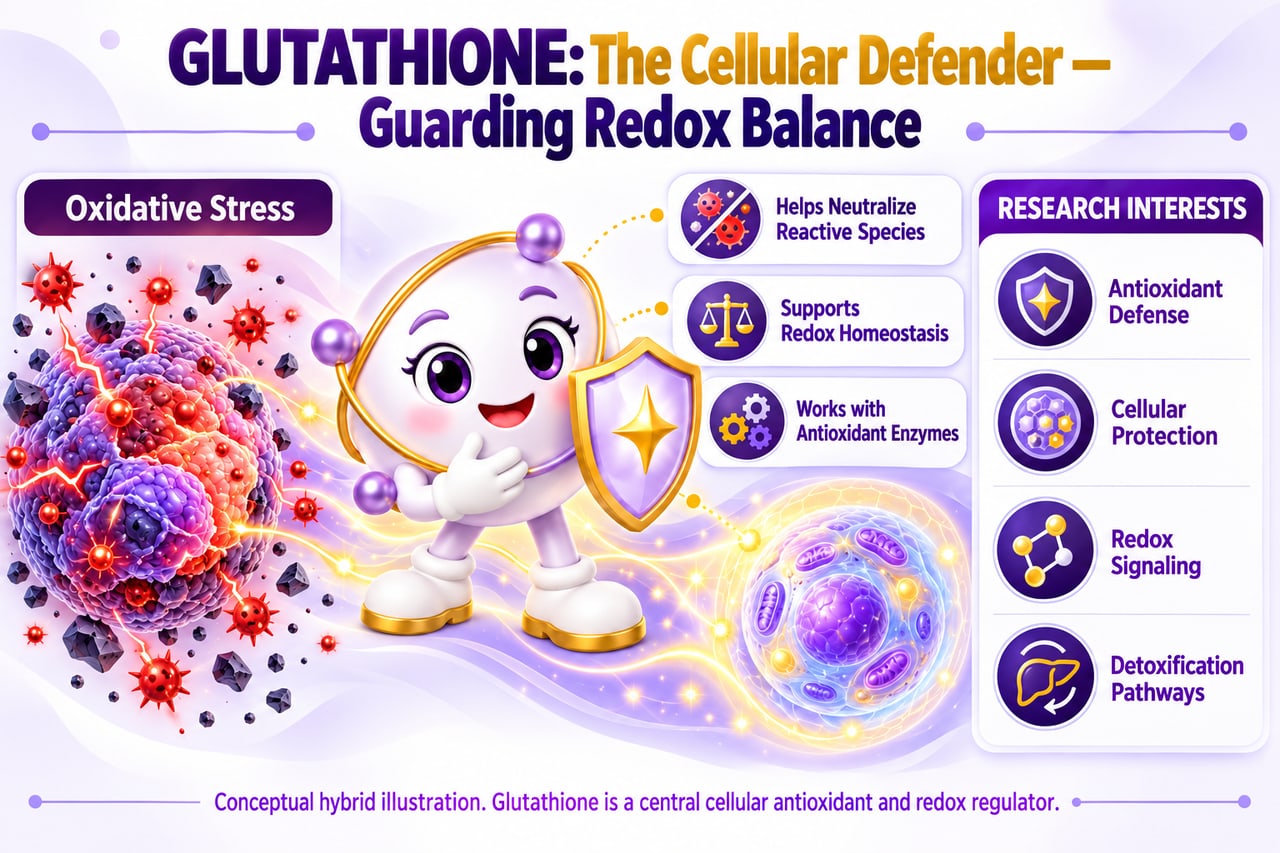
Glutathione (GSH) is a naturally occurring tripeptide that your body produces. Unlike many peptides that act primarily as signaling messengers, glutathione works mainly as an antioxidant and cellular defense molecule.
It helps maintain a healthy balance between oxidation and antioxidant activity, protecting important cellular structures such as DNA, proteins, and cell membranes.
Glutathione is especially important in the liver, where it participates in several processes that help the body handle potentially harmful substances.
The liver is one of the body's major processing and elimination organs, and glutathione plays an important role in its natural detoxification system.
During a process called Phase II detoxification, liver enzymes known as glutathione S-transferases attach glutathione to certain compounds. This process, called conjugation, can make those compounds easier for the body to transport and eliminate.
Depending on the compound, the resulting products may leave the body through bile and the digestive tract or through the kidneys and urine.
In everyday language, glutathione helps the liver package certain substances for removal.
Normal metabolism, environmental exposures, and immune activity can produce reactive oxygen species — unstable molecules that may damage cells when they accumulate.
Glutathione helps neutralize these reactive molecules, reducing oxidative stress and helping protect cellular components.
Glutathione works in two main forms: reduced glutathione (GSH) and oxidized glutathione (GSSG).
With the help of enzymes, the body recycles oxidized glutathione back into its active reduced form. This recycling system helps maintain the cell's internal antioxidant balance.
Glutathione is an essential partner for several enzyme systems, including:
These systems work together to protect cells and support the body's natural processing and elimination pathways.
The liver constantly processes substances that enter the body or are produced through normal metabolism. Glutathione is particularly important because it helps protect liver cells from oxidative stress while supporting the chemical reactions involved in processing certain compounds.
Researchers study glutathione in connection with:
Glutathione is essential to normal liver function.
Glutathione continues to be studied in several areas:
Researchers are also studying different ways to support glutathione levels, including oral glutathione and precursor compounds such as N-acetylcysteine (NAC), which supplies cysteine for the body's own glutathione production.
Yes. Glutathione is studied in several forms, and the route of administration can affect how it is absorbed and distributed.
These forms should not be assumed to have the same effects or evidence behind them.
Glutathione's role as an antioxidant and its involvement in liver Phase II detoxification are well established aspects of human biology.
The more difficult question is whether taking extra glutathione produces meaningful improvements in health. Human research is still developing, and results depend on the formulation, route, population, and outcome.
Glutathione is much more than an antioxidant. It is a central part of the body's cellular defense system and an important partner in the liver's natural detoxification machinery.
It helps neutralize reactive molecules, maintain cellular redox balance, and assist liver enzymes in processing certain compounds for elimination.
The big idea: Your body already makes glutathione because it needs it. Researchers are continuing to investigate whether supporting glutathione levels can offer additional benefits — and which forms, if any, produce meaningful improvements in human health.
Peptide Curious provides educational and editorial content only. It is not medical advice and is not a substitute for a qualified healthcare professional. Glutathione is discussed here as a research compound; content may describe emerging research not approved for clinical use.