The Longevity Timekeeper
Epitalon
A tiny four-amino-acid peptide studied for telomeres, the body's internal clock, and healthy aging.
4 amino acids (tetrapeptide)
Based on a pineal gland extract
Studied in aging research

A tiny four-amino-acid peptide studied for telomeres, the body's internal clock, and healthy aging.
Every time a cell divides, it copies its DNA. At the ends of each chromosome are protective caps called telomeres. Think of them as the plastic tips on shoelaces: they stop the ends from fraying.
Telomeres get a little shorter every time a cell divides, which is one reason scientists study them in aging research. An enzyme called telomerase can rebuild them.
Epitalon, also spelled Epithalon, is a synthetic peptide made of just four amino acids: alanine, glutamic acid, aspartic acid, and glycine. Russian researchers designed it from the amino-acid makeup of epithalamin, an extract of the pineal gland, the small gland deep in the brain that helps set the body's daily rhythm by producing melatonin.
Think of Epitalon as a timekeeper research peptide: scientists are exploring whether a tiny peptide can influence the cell-level clocks involved in aging.
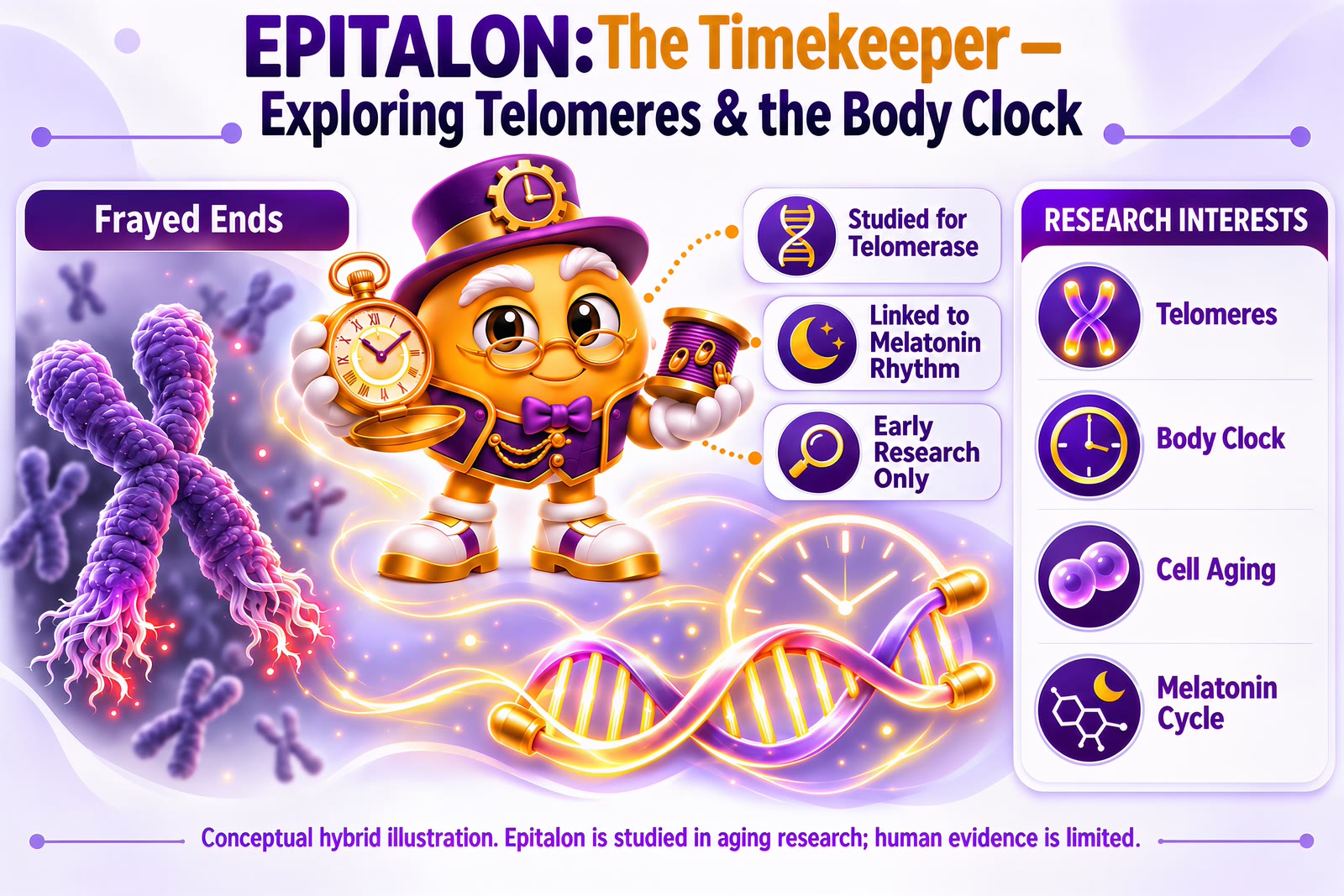
In laboratory experiments with cultured human cells, Epitalon has been reported to switch on telomerase and lengthen telomeres.
Why does this matter? Telomere length is one of the markers researchers use to study cell aging.
It is also an important limit to keep in mind: longer telomeres in a dish do not mean longer life in a person. Cells in culture are not the same as an adult human body.
Because Epitalon is based on a pineal extract, researchers have studied whether it influences melatonin, the hormone that helps regulate the sleep-wake cycle, and the body's daily rhythm more broadly.
Studies in rodents have looked at lifespan and other measures of aging. The results have been mixed: some experiments reported longer lifespan in certain groups of animals, others found little change.
Most of this work has come from a small number of research groups.
Human data are limited to small studies of biomarkers and body-clock measures, mostly from the Russian group that developed it, plus observational work on the related pineal extract. No large, independent clinical trials have confirmed these findings.
Epitalon was developed in the 1990s by Professor Vladimir Khavinson and colleagues at the St. Petersburg Institute of Bioregulation and Gerontology in Russia. A 2025 review described about 25 years of research on it, and noted how much basic information is still missing.
Epitalon is not FDA-approved as a medication in the United States.
Most peptides on this site are studied for a specific job: repairing tissue, calming inflammation, supporting cellular energy. Epitalon is studied for something larger and much harder to measure: the process of aging itself.
That is what makes it exciting to researchers, and it is also why the evidence is so hard to pin down.
Epitalon is a small peptide with an interesting origin, a clear laboratory story about telomerase, and very little high-quality human evidence.
The Peptide Curious takeaway: Think of Epitalon as a timekeeper's tool. Researchers are exploring whether it can influence the cellular clocks that tick in the background of aging.
Peptide Curious provides educational and editorial content only. It is not medical advice and is not a substitute for a qualified healthcare professional. Epitalon is discussed here as a research/investigational compound; content may describe emerging research not approved for clinical use.