Getting Resources There
TB-500
The cellular recovery coordinator, exploring cell movement, blood vessel formation, and tissue repair.
Fragment of Thymosin Beta-4
Acts on actin (cell scaffolding)
Studied for cell migration

The cellular recovery coordinator, exploring cell movement, blood vessel formation, and tissue repair.
When the body experiences an injury, repairing the damage requires more than simply producing new tissue. Cells must travel to the affected area, blood vessels must deliver oxygen and nutrients, and damaged tissue must reorganize as it recovers.
That's where TB-500 research comes in.
TB-500 is commonly described as a synthetic seven-amino-acid fragment associated with a larger naturally occurring protein called Thymosin Beta-4 (TB-4).
Researchers are interested in TB-4 and related fragments because of their relationship to actin, a protein that helps cells maintain their shape, move, and reorganize.
Think of TB-500 as a cellular logistics coordinator: the research question is whether it can help coordinate some of the processes involved in tissue repair.
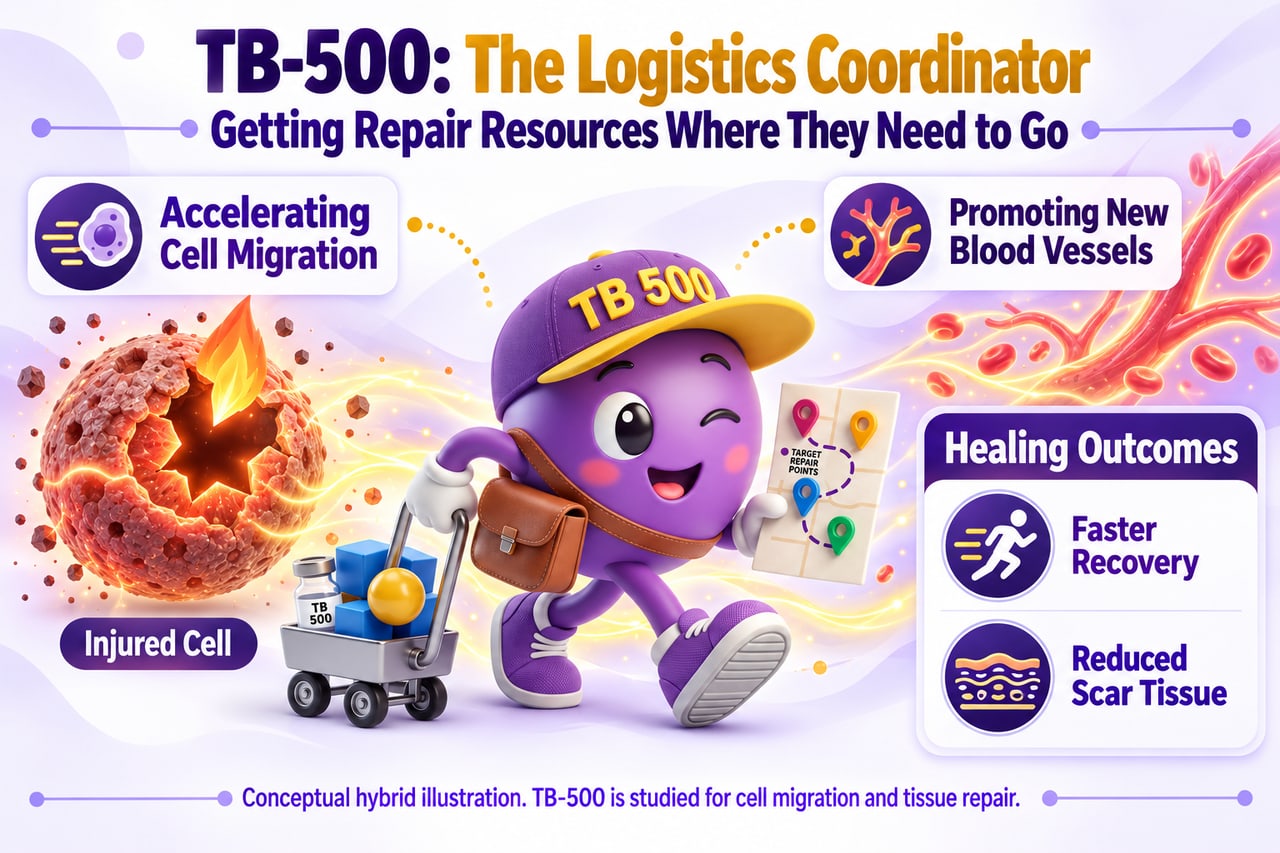
One of the most interesting research areas involves a process called cell migration.
When tissue is damaged, certain cells need to move toward the affected area to participate in repair.
Actin is an important part of this process. It acts like an internal framework that allows cells to change shape and move.
The actin-related sequence associated with TB-500 has been studied for its potential influence on cellular movement.
Why does this matter?
Repairing tissue requires a supply of oxygen and nutrients.
The formation of new blood vessels is called angiogenesis.
Thymosin Beta-4 research has explored how this protein and related sequences may influence the movement of endothelial cells, which line blood vessels.
This is particularly interesting because healthy circulation helps provide the resources needed for normal tissue maintenance and repair.
When tissue heals, it needs to reorganize.
Excessive scar formation can sometimes leave tissue stiff or less flexible.
Researchers have investigated whether Thymosin Beta-4-related pathways influence tissue remodeling and the organization of repair tissue.
The goal is to understand how tissue can recover its structure and function rather than simply forming replacement material.
Research involving Thymosin Beta-4 has explored several repair-related processes, including:
These processes are relevant to understanding how the body responds to injury.
However, an important distinction is that much of this research involves the full-length Thymosin Beta-4 protein or other related experimental fragments, not necessarily the specific TB-500 product marketed today.
Thymosin Beta-4-related research has explored:
These are research areas, not proven treatment applications for TB-500.
Both peptides are frequently discussed in regenerative research, but their proposed mechanisms are different.
Researchers investigate BPC-157 in relation to:
Research involving TB-4-related peptides focuses on:
Think of it this way:
BPC-157 research focuses on the building and protection processes, while TB-500 research focuses on how cells move and coordinate during repair.
They are different research subjects, not interchangeable compounds.
The body has an incredibly sophisticated repair system.
It requires cells to communicate, move, organize, and work together.
Thymosin Beta-4 research has opened interesting questions about how actin-related processes influence cellular movement and tissue recovery.
This is why TB-500 continues to attract attention in regenerative and tissue-repair research.
TB-500 is an interesting research compound associated with Thymosin Beta-4 and cellular repair pathways.
Its primary research interest involves cell migration, actin regulation, blood vessel development, and tissue remodeling.
The Peptide Curious takeaway: Think of TB-500 as the logistics coordinator of cellular repair. The research explores how cells move, organize, and participate in the body's natural recovery processes.
Educational and editorial content only. Not medical advice. TB-500 is discussed as a research compound; content may describe emerging research not approved for clinical use.