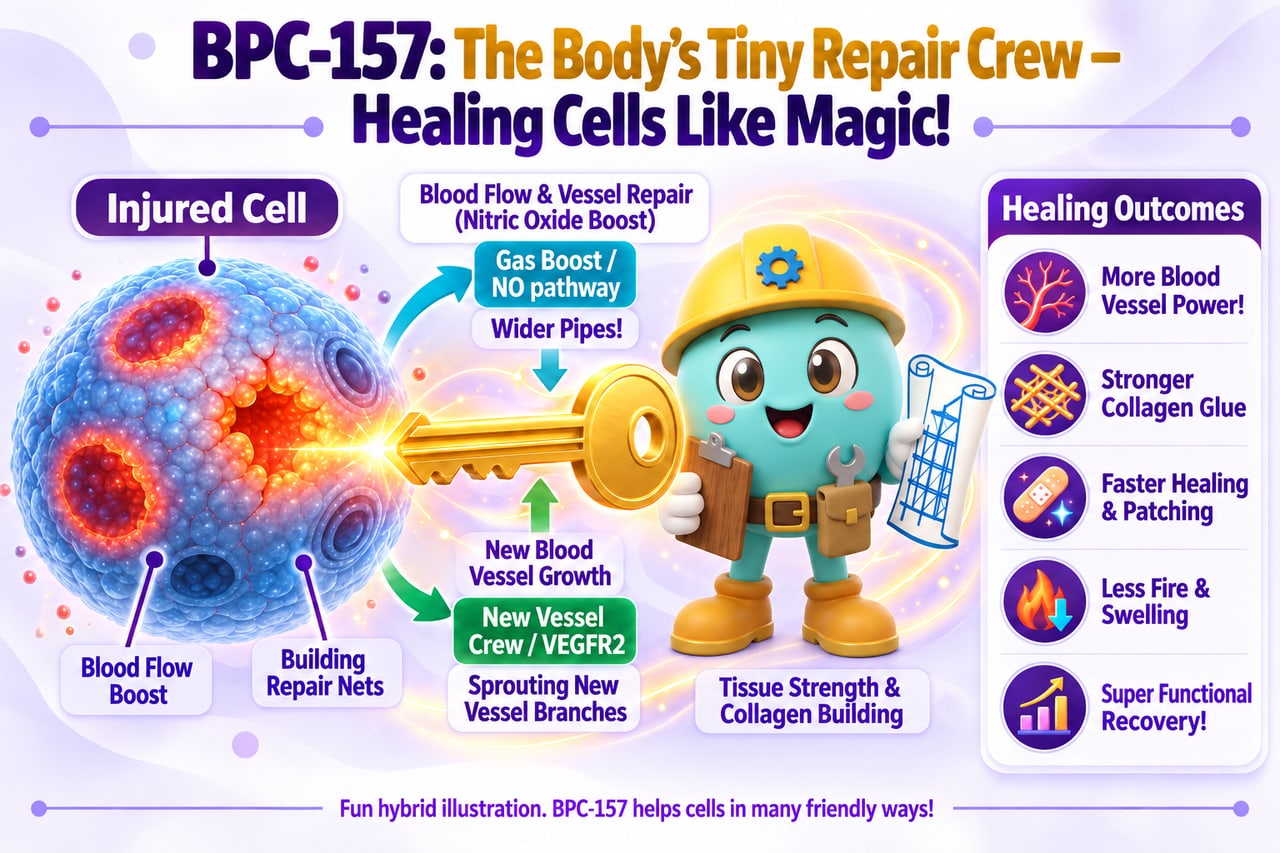
The body's tiny repair crew, supporting tissue repair, blood flow, collagen production, and cellular protection.
15 amino acids (pentadecapeptide)Found in human stomach juiceStudied mostly in vitro / in animals
Imagine your body has a construction crew that goes to work whenever something needs repairing.
Muscles, tendons, ligaments, blood vessels, and other tissues all depend on coordinated repair processes to recover from damage.
BPC-157 is a small peptide made up of just 15 amino acids. It is derived from a protein sequence associated with the stomach and has become an interesting subject of regenerative medicine research.
Researchers are investigating how BPC-157 may influence several of the body's natural repair pathways.
Conceptual overview. BPC-157 is studied for effects on several cellular repair pathways at once — this is a simplified overview, not a claim of clinical effect.
How BPC-157 May Support the Repair Process
1. Supports Blood Flow to Damaged Tissue
For tissue to repair itself, it needs oxygen and nutrients.
BPC-157 has been studied for its effects on nitric oxide signaling, particularly through an enzyme called eNOS.
Nitric oxide helps blood vessels relax, allowing blood to flow more easily.
Why does this matter?
Better circulation can help deliver oxygen and nutrients.
Healthy blood vessels support tissue recovery.
Improved blood flow may help create an environment favorable to repair.
Think of it as improving the delivery routes that bring building materials to a construction site.
2. Encourages the Formation of New Blood Vessels
This is one of the most interesting areas of BPC-157 research.
The process of forming new blood vessels is called angiogenesis.
BPC-157 has been investigated for its effects on VEGFR2, a receptor involved in blood vessel development.
In laboratory and animal studies, researchers have observed changes in signaling associated with new blood vessel formation.
Why is this important?
New blood vessels can help deliver oxygen and nutrients to areas undergoing repair.
3. Supports Collagen Production and Tissue Strength
Collagen is one of the body's most important structural proteins.
It provides strength and support to:
Tendons.
Ligaments.
Muscles.
Skin.
Connective tissue.
BPC-157 has been studied for its effects on fibroblasts, the cells responsible for producing collagen and helping rebuild connective tissue.
Researchers have investigated signaling pathways involving FAK and ERK, which play roles in cell growth, movement, and tissue repair.
The goal is to understand whether BPC-157 can help support stronger, better-organized repair tissue.
4. Helps Regulate Inflammatory Activity
Inflammation is a normal part of the body's repair response.
However, excessive or prolonged inflammation can interfere with healthy tissue function.
Preclinical BPC-157 research has identified effects on certain inflammatory signaling pathways.
Researchers are investigating whether these effects may help:
Reduce excessive inflammatory activity.
Protect cells from certain forms of stress.
Support healthier tissue recovery.
Coordinate the body's repair response.
5. Protects Cells and Supports Tissue Integrity
BPC-157 is also being studied for its potential cytoprotective effects.
Cytoprotection simply means helping protect cells from damage.
Researchers have explored this in different tissues and experimental models, including gastrointestinal, muscle, tendon, and ligament injury models.
This broader research interest is one reason BPC-157 has attracted so much attention in regenerative medicine.
What Types of Tissue Are Being Studied?
Researchers have investigated BPC-157 in experimental models involving:
Tendons and ligaments: Structural repair and connective tissue recovery.
Muscles: Recovery following muscle injury.
Bones: Healing and repair processes.
Digestive system: Protection of gastrointestinal tissue.
Blood vessels: Circulation and new vessel formation.
Connective tissue: Collagen production and tissue organization.
Why Is BPC-157 So Interesting?
Most repair processes involve several systems working together.
BPC-157 is particularly interesting because researchers are investigating its influence on multiple pathways rather than just one isolated process.
These include:
Nitric oxide signaling for blood vessel function.
VEGFR2 signaling for blood vessel formation.
Fibroblast activity for collagen production.
FAK and ERK signaling for cellular repair processes.
Inflammatory pathways involved in tissue recovery.
In simple terms, researchers are exploring how one small peptide might influence several parts of the body's repair machinery.
The Bottom Line
BPC-157 has generated considerable interest because of its potential relationship to tissue repair, blood flow, collagen formation, and cellular protection.
Its research is especially interesting in the areas of muscle, tendon, ligament, and gastrointestinal tissue.
The Peptide Curious takeaway: Think of BPC-157 as the construction coordinator. Researchers are investigating how it may help direct the processes that bring oxygen, support collagen production, and coordinate tissue repair.
Important research note: Most BPC-157 evidence comes from laboratory and animal studies. Human clinical evidence remains extremely limited, and its safety and effectiveness have not been established. BPC-157 is not FDA-approved for human medical use. Proposed mechanisms and potential benefits should not be interpreted as proven clinical outcomes.
Keep exploring
How peptides work — receptors, signaling, and why petri-dish results don't transfer directly to people
Harm reduction — if people are going to research these compounds anyway
TB-500 — the peptide most often mentioned in the same breath
Peptide Curious provides educational and editorial content only. It is not medical advice and is not a substitute for a qualified healthcare professional. BPC-157 is discussed here as a research compound; content may describe emerging research not approved for clinical use.