The mitochondrial energy specialist, supporting cellular energy, mitochondrial function, and protection against oxidative stress.
4 amino acids (synthetic)Binds cardiolipinMost clinically advanced of the mitochondrial peptides here
Every cell in your body needs energy to function. That energy is produced primarily by tiny structures inside cells called mitochondria.
Mitochondria are often called the powerhouses of the cell because they help convert nutrients into ATP, the energy currency your body uses to carry out essential functions.
But mitochondria can become damaged or less efficient due to aging, disease, inflammation, and oxidative stress.
That's where SS-31 comes into the picture.
SS-31, also known as elamipretide, is a synthetic peptide made up of just four amino acids. Unlike MOTS-c, which originates from mitochondrial DNA and acts as a cellular signal, SS-31 was specifically designed to travel into mitochondria and interact with their inner membranes.
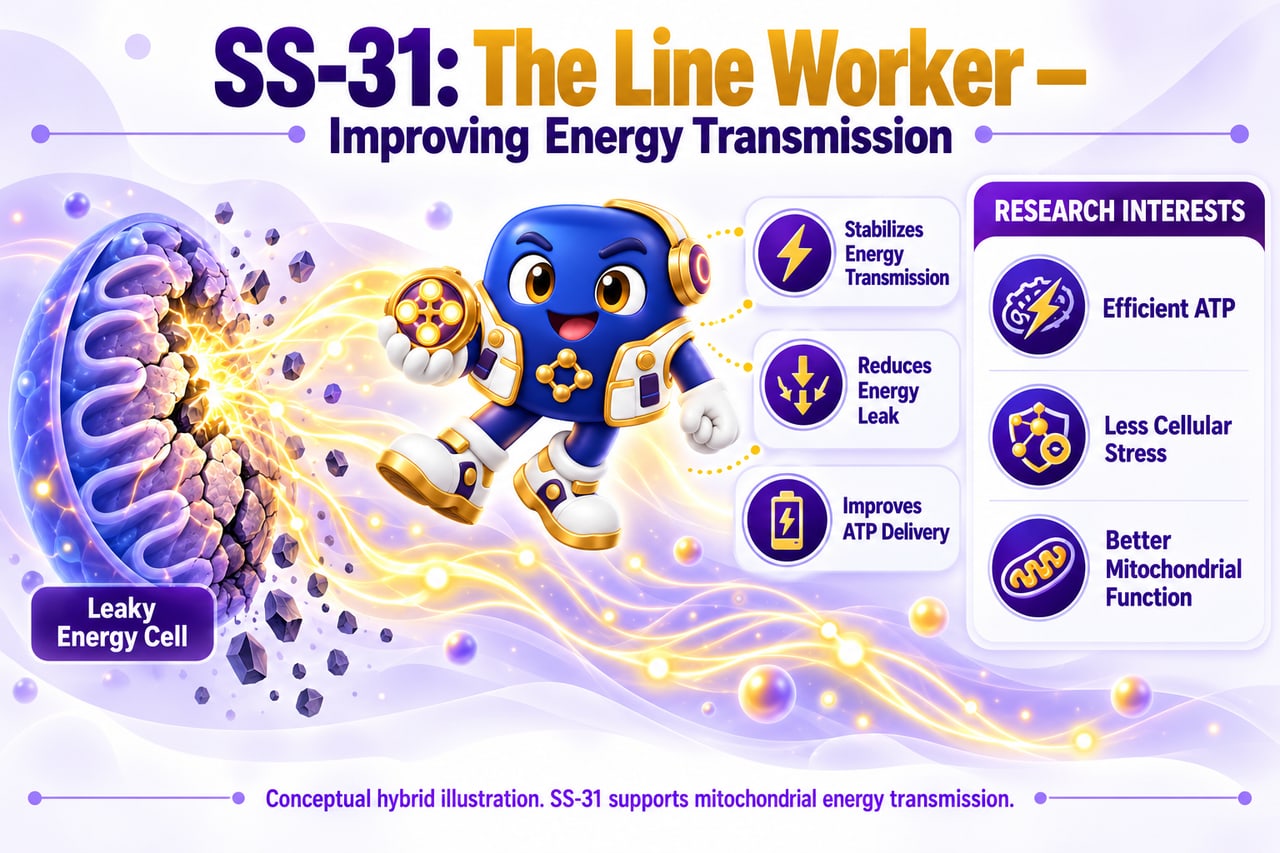
Think of SS-31 as the transmission specialist: researchers are investigating how it may help stabilize the machinery responsible for producing cellular energy.
Conceptual overview. SS-31 is studied for stabilising mitochondrial energy transmission — a simplified overview, not a clinical claim.
How SS-31 May Support Mitochondrial Health
1. Helps Stabilize the Mitochondrial Membrane
One of the most important features of SS-31 is its relationship with cardiolipin.
Cardiolipin is a special fat found primarily in the inner membrane of mitochondria. It helps maintain the structure and organization of the machinery responsible for energy production.
When cardiolipin and the mitochondrial membrane become disrupted, energy production can become less efficient.
SS-31 binds to cardiolipin and has been studied for its ability to:
Support mitochondrial membrane structure.
Maintain the organization of energy-producing proteins.
Improve mitochondrial function in experimental models.
Reduce certain forms of mitochondrial stress.
In simple terms, SS-31 is being studied for its ability to help keep the cell's energy-producing machinery organized.
2. Supports ATP Production
ATP is the energy your cells use to perform everyday functions.
Your muscles need it to contract. Your heart needs it to beat. Your brain needs it to communicate. Every organ depends on it.
When mitochondria become dysfunctional, ATP production can become less efficient.
Research suggests SS-31 may help improve mitochondrial energy production under certain disease-related conditions.
Researchers are investigating its potential to:
Support the electron transport chain.
Improve mitochondrial energy efficiency.
Maintain ATP production.
Help stressed cells manage energy demands.
This is particularly interesting in tissues with high energy requirements, such as the heart and skeletal muscles.
3. Helps Reduce Oxidative Stress
As mitochondria produce energy, they also generate reactive oxygen species (ROS).
Small amounts of ROS are normal and play a role in cellular signaling. Excessive amounts, however, can contribute to oxidative damage.
SS-31 is being studied for its ability to reduce excessive mitochondrial ROS production.
Why does this matter?
Excessive oxidative stress can affect:
Mitochondrial membranes.
Cellular proteins.
DNA.
Normal energy production.
Cellular health and function.
By interacting with cardiolipin and mitochondrial membranes, SS-31 may help reduce certain forms of mitochondrial oxidative stress.
4. Supports Heart and Muscle Function
The heart and skeletal muscles are especially dependent on healthy mitochondria.
Research involving SS-31 has explored its potential effects in:
Heart muscle dysfunction.
Mitochondrial muscle disorders.
Muscle weakness.
Reduced blood flow and reperfusion injury.
Age-related mitochondrial changes.
This is one reason SS-31 has received considerable attention in cardiovascular and mitochondrial disease research.
SS-31 and Cancer Research: What Are Scientists Discovering?
This is a particularly interesting area of research.
Researchers are investigating whether improving mitochondrial function may help protect healthy tissues from some of the damage associated with cancer and cancer treatments.
There are several interesting research directions.
1. Investigating Cancer-Related Muscle Wasting
Cancer can sometimes cause a condition called cachexia.
Cachexia is more than ordinary weight loss. It involves the loss of muscle mass, weakness, and changes in the body's metabolism.
Mitochondrial dysfunction is one of the processes being investigated in cancer-related muscle wasting.
In a 2021 study, researchers examined SS-31 in mice carrying C26 tumors, a model used to study cancer cachexia.
They found that SS-31:
Partially improved certain features of cancer-related muscle wasting.
Helped preserve aspects of muscle and respiratory muscle function.
Improved aspects of whole-body energy metabolism.
Did not increase tumor growth in that particular animal model.
This is an important finding because it suggests mitochondrial support may have potential relevance to the physical complications of cancer.
2. Investigating Protection Against Chemotherapy-Related Damage
Some chemotherapy medications can damage healthy cells along with cancer cells.
Doxorubicin, for example, is an effective cancer medication that can cause damage to heart muscle.
Researchers are investigating whether SS-31 may help protect mitochondria in healthy heart cells from some of this treatment-related damage.
Preclinical research has explored whether SS-31 may:
Reduce excessive mitochondrial oxidative stress.
Support mitochondrial membrane function.
Reduce certain markers of heart-cell injury.
Help preserve normal cellular energy processes.
A 2026 laboratory study also investigated SS-31 in heart cells exposed to radiation. Researchers observed reductions in several markers of radiation-associated cellular aging and oxidative stress.
These findings are promising research directions.
3. Does SS-31 Fight Cancer Cells?
Cancer cells have their own altered energy systems. Some rely heavily on mitochondrial activity, while others use different metabolic pathways depending on the type of cancer.
SS-31 affects mitochondrial function, but that does not automatically mean it can selectively damage cancer cells or stop tumors from growing.
In fact, because SS-31 is being investigated for its cell-protective properties, researchers need to understand whether it could also protect cancer cells under certain conditions.
The important distinction: Research into protecting healthy cells during cancer treatment is not the same as research demonstrating an anticancer effect.
Why Is SS-31 Different From MOTS-c?
Both peptides are associated with mitochondrial research, but they work differently.
MOTS-c: The Metabolic Signaling Peptide
Research focuses on:
AMPK and cellular energy sensing.
Insulin sensitivity.
Glucose metabolism.
Fat utilization.
Metabolic flexibility.
SS-31: The Mitochondrial Transmission Specialist
Research focuses on:
Cardiolipin binding.
Mitochondrial membrane structure.
ATP production.
Oxidative stress.
Cellular energy machinery.
Think of MOTS-c as the messenger helping cells respond to energy demands, while SS-31 is the specialist working directly with the mitochondrial machinery.
Has SS-31 Been Approved as a Medication?
SS-31 has progressed further through clinical development than many research peptides.
In September 2025, the FDA granted accelerated approval to elamipretide hydrochloride, marketed as Forzinity, for adults and pediatric patients weighing at least 30 kilograms with Barth syndrome.
Barth syndrome is a rare genetic condition that affects cardiolipin and mitochondrial function.
This is significant because it represents an actual FDA-approved medical application for elamipretide.
The Bottom Line
SS-31 is an exciting area of mitochondrial research because it works directly with cardiolipin, a key component of the mitochondrial inner membrane.
Researchers are investigating its potential to support cellular energy production, reduce excessive oxidative stress, and maintain mitochondrial function.
Cancer research adds another interesting dimension, particularly in studies involving cancer-related muscle wasting and the protection of healthy tissues during cancer treatment.
The Peptide Curious takeaway: Think of SS-31 as the mitochondrial transmission specialist. Researchers are exploring how it may help keep the machinery that powers your cells working more efficiently.
Important research note: Evidence varies substantially by application. SS-31 has FDA accelerated approval as Forzinity for a specific Barth syndrome indication, but it is not approved as a cancer treatment. Cancer-related findings described here are primarily preclinical.
Keep exploring
MOTS-c — the signaling side of mitochondrial peptide research
Educational and editorial content only. Not medical advice. SS-31 is discussed here as a research/investigational compound; content may describe emerging research not approved for clinical use.