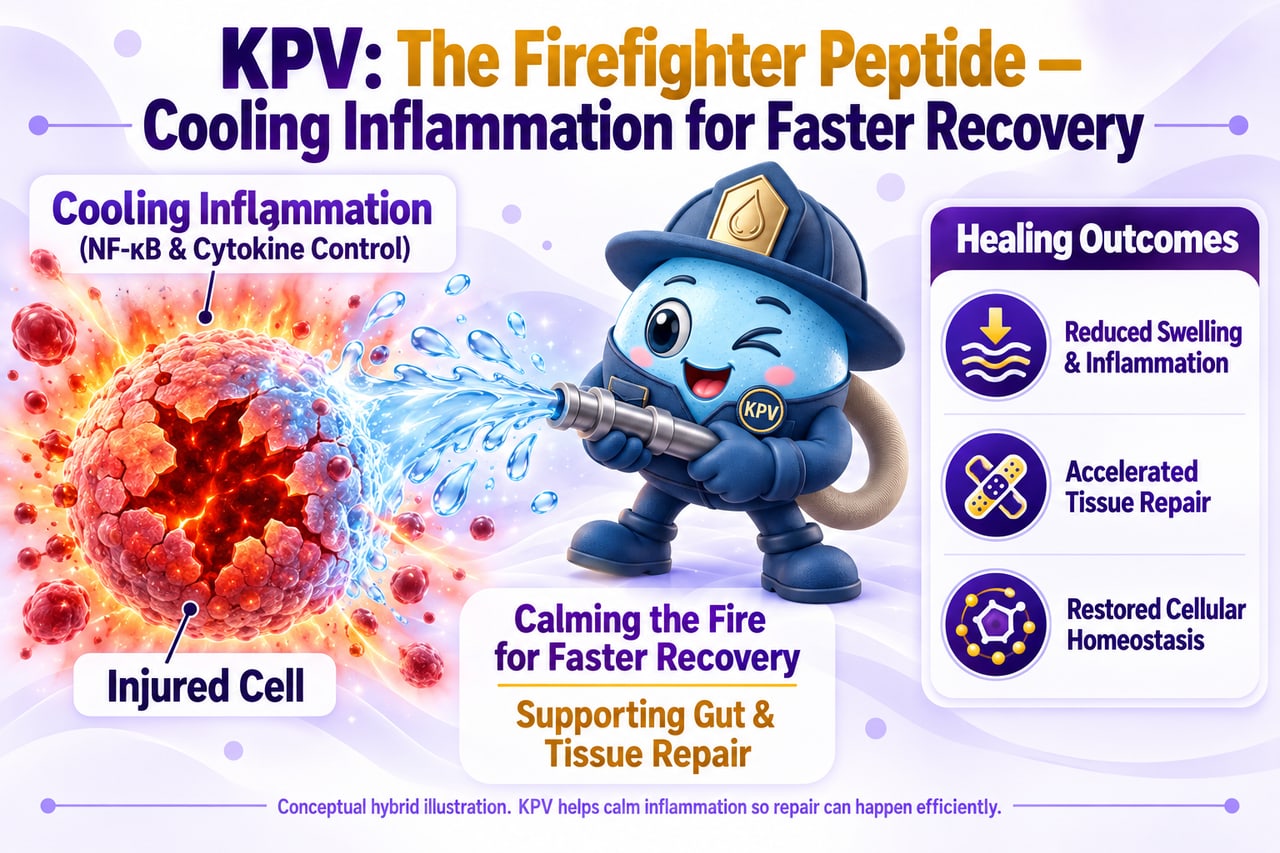
The peptide that helps calm inflammation, supporting gut health, skin health, and the body's natural repair processes.
3 amino acids (Lys–Pro–Val)Fragment of alpha-MSHStudied for inflammation signaling
Think of inflammation as your body's alarm system. It's designed to protect you when something is wrong. But when that alarm stays switched on for too long, inflammation can contribute to irritation, discomfort, and ongoing tissue damage.
That's where KPV research gets interesting.
KPV is a tiny peptide made up of just three amino acids: lysine, proline, and valine. It comes from alpha-MSH, a natural hormone produced by the body that has anti-inflammatory properties.
Researchers are studying KPV for its potential to help calm excessive inflammatory activity and support the body's natural healing environment.
Conceptual overview. KPV is studied for dialing down inflammatory signaling so normal repair can proceed — a simplified overview, not a clinical claim.
How KPV May Work
1. Helps Calm Inflammatory Signals
One of the main areas of KPV research is its effect on NF-κB, a signaling pathway that helps control inflammation.
When this pathway becomes overactive, it can trigger the release of inflammatory messengers called cytokines.
KPV is being studied for its ability to reduce this excessive signaling, potentially helping calm inflammation at the cellular level.
In simple terms: KPV may help turn down the body's inflammatory alarm.
2. Supports Gut Health
The gut lining acts as a protective barrier between the contents of your digestive system and the rest of your body.
Inflammation can interfere with this barrier and irritate the intestinal lining.
Researchers are investigating KPV's potential to:
Calm inflammatory activity in the digestive tract.
Support the integrity of the intestinal lining.
Help create an environment that supports normal tissue repair.
Reduce inflammatory signaling associated with intestinal irritation.
This is one of the particularly interesting areas of KPV research.
3. Supports Skin and Tissue Health
Inflammation plays an important role in skin irritation and tissue damage.
KPV is being studied in skin and tissue models for its potential to reduce inflammatory responses and support normal repair processes.
The goal is not simply to suppress inflammation, but to help restore a healthier balance so the body's natural repair mechanisms can function.
4. Works With the Body's Natural Inflammatory Pathways
Unlike approaches that broadly suppress immune activity, KPV research focuses on specific inflammatory signaling pathways.
This makes it an interesting research subject for understanding how inflammation might be regulated without unnecessarily interfering with normal immune functions.
However, its selectivity and safety in humans have not yet been established.
Why Is KPV So Interesting?
KPV is only three amino acids long, making it an exceptionally small peptide.
Its small size and relationship to alpha-MSH have made it particularly interesting to researchers investigating cellular inflammatory signaling.
Rather than focusing on just one area of the body, research has explored its potential relevance to:
Gut inflammation.
Skin irritation.
Inflammatory cytokines.
Tissue repair.
Cellular inflammatory pathways.
The Bottom Line
KPV is often called the "firefighter peptide" because its research centers on helping calm excessive inflammatory signals.
Its potential applications in gut health, skin health, and tissue repair make it an interesting area of peptide research.
The big idea? Sometimes supporting the body's ability to heal means first understanding how to calm the inflammation that gets in the way.
Peptide Curious takeaway: KPV is a fascinating example of how a very small peptide may influence some of the body's most important inflammatory signaling pathways.
Important research note: Most KPV evidence currently comes from laboratory and animal studies. Human clinical evidence is limited, and KPV is not an approved medication. Potential benefits described here are research interests, not established treatment outcomes.
Educational and editorial content only. Not medical advice. KPV is discussed as a research compound; content may describe emerging research not approved for clinical use.