The skin and cellular renewal peptide, supporting collagen, skin firmness, connective tissue, and natural repair.
Gly–His–Lys + copper(II)Declines ~200 → ~80 ng/mL by age 60Strongest human evidence: topical skin
What if your body had a natural way to help maintain the structure and appearance of your skin?
That's what makes GHK-Cu so interesting to researchers.
GHK-Cu is a naturally occurring copper peptide made up of three amino acids: glycine, histidine, and lysine, combined with a copper ion.
It is found naturally in the body and is being studied for its role in collagen production, skin structure, tissue repair, and cellular protection.
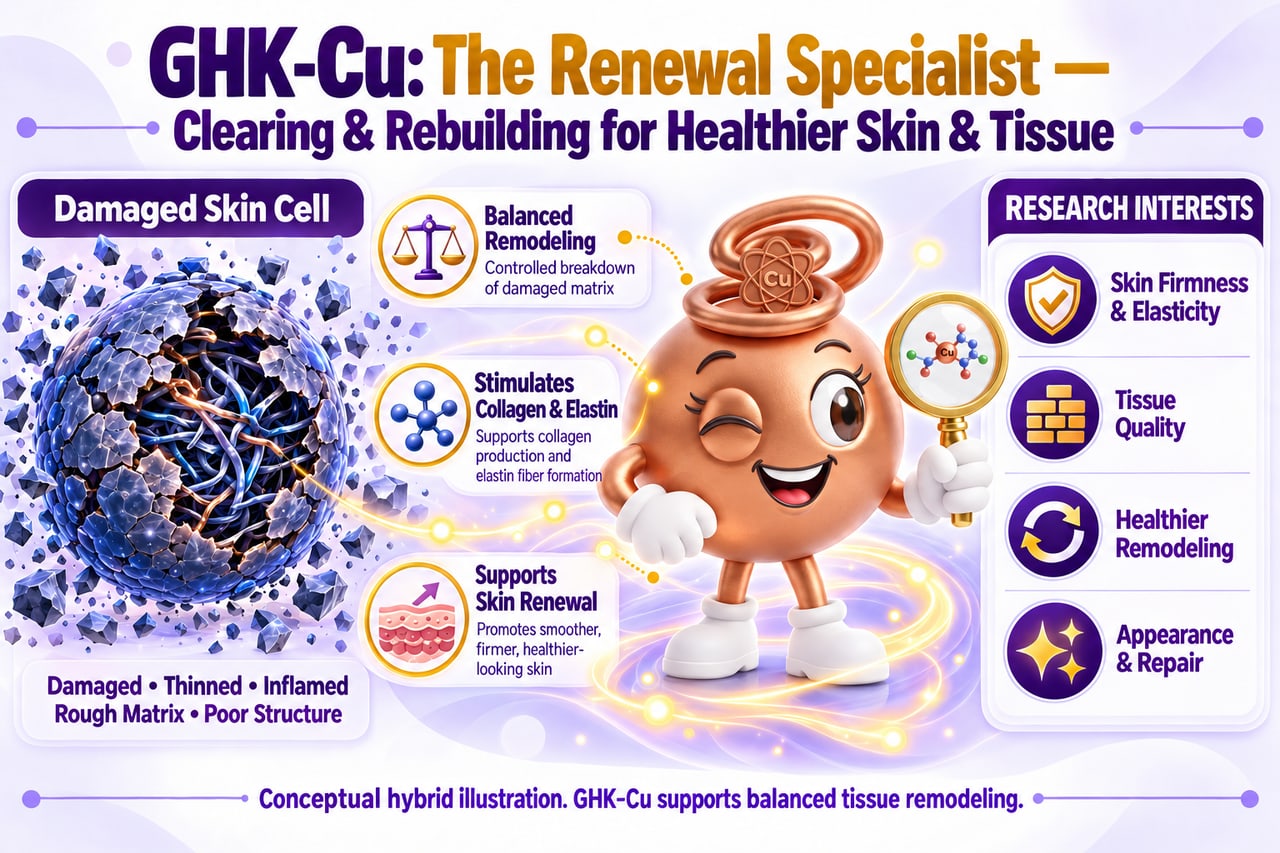
Think of GHK-Cu as the body's renewal specialist: researchers are exploring how it may help clear damaged tissue components and support the rebuilding of healthy structural material.
Conceptual overview. GHK-Cu is studied for helping remove worn-out matrix while encouraging higher-quality rebuilding — a simplified overview, not a clinical claim.
How GHK-Cu May Support Skin and Tissue Health
1. Supports Collagen and Elastin Production
Collagen and elastin are two important proteins that help keep skin firm, strong, and flexible.
Collagen provides structure and support.
Elastin helps skin stretch and return to its original shape.
Fibroblasts are the cells responsible for producing these important proteins.
Laboratory research suggests GHK-Cu can influence fibroblast activity and collagen production.
Why does this matter?
As skin ages, its structural support changes. Researchers are interested in whether GHK-Cu can help support the processes involved in maintaining healthier-looking skin.
2. Supports Skin Firmness and Elasticity
Healthy skin depends on an organized network of collagen, elastin, and other structural materials.
GHK-Cu is being studied for its influence on the extracellular matrix, which is the supportive framework surrounding skin cells.
Research has explored its potential to:
Support collagen production.
Influence elastin and other structural proteins.
Support skin thickness and structure.
Promote healthier-looking skin texture.
These properties make it particularly interesting in cosmetic and skin-aging research.
3. Helps Support the Skin's Natural Renewal Process
Skin is constantly breaking down old or damaged material and replacing it with new structural components.
This process is called tissue remodeling.
GHK-Cu is interesting because researchers have studied its potential to influence both sides of this process:
Clearing: Helping regulate enzymes involved in breaking down damaged or disorganized tissue material.
Rebuilding: Supporting fibroblast activity and the production of new structural components.
Think of it as renovating a house: sometimes you need to clear away worn-out materials before rebuilding a stronger structure.
4. Supports Cellular Protection
Copper is an important mineral that helps certain enzymes perform essential functions in the body.
Some of these enzymes help protect cells against oxidative stress, which occurs when damaging molecules called free radicals accumulate.
GHK-Cu is being studied for its relationship with copper-dependent antioxidant enzymes and its potential to help regulate cellular stress responses.
5. Supports Blood Vessel Formation and Tissue Repair
Healthy tissue needs oxygen and nutrients delivered through the bloodstream.
Researchers have investigated GHK-Cu's relationship with angiogenesis, the process of forming new blood vessels.
This research is particularly interesting in understanding how skin and other tissues maintain their structure and respond to damage.
What Is GHK-Cu Being Studied For?
GHK-Cu has attracted interest in several areas:
Skin aging: Collagen, skin firmness, elasticity, and texture.
Skin renewal: Cellular remodeling and structural support.
Hair research: Potential effects on hair follicle biology.
Wound research: Tissue remodeling and repair.
Cellular protection: Antioxidant and inflammatory signaling.
These are research areas, not established medical treatment benefits.
Why Is GHK-Cu Different From Other Peptides?
GHK-Cu has a particularly interesting relationship with copper.
Copper is needed for enzymes involved in collagen cross-linking, which helps give connective tissue its strength and structure.
GHK binds copper and forms a complex that researchers have studied for its effects on tissue remodeling and cellular activity.
This makes GHK-Cu different from peptides such as BPC-157 and TB-500, which are investigated through different biological pathways.
The Bottom Line
GHK-Cu is one of the most interesting peptides in skin and regenerative research because of its relationship with collagen, elastin, cellular protection, and tissue remodeling.
Its greatest research interest currently centers on skin health and cosmetic applications.
The Peptide Curious takeaway: Think of GHK-Cu as the renewal specialist. Researchers are exploring how it may help support the structural proteins, cellular processes, and natural renewal mechanisms that keep skin healthy and resilient.
Important research note: Although GHK-Cu has been studied for decades, much of the evidence comes from laboratory and animal studies. Human studies are relatively small and limited, with mixed findings. Evidence from topical cosmetic products cannot automatically be applied to injectable or systemic use. GHK-Cu is not an FDA-approved treatment for aging, hair loss, or tissue repair.
Keep exploring
KPV — also studied for the "calm the damage, then rebuild" pattern